RASPlanning
UAE Shrimp Farm RAS Design
Aqua Bridge - 250 MT Annual Production
Client
Aqua Bridge / Confidential Client, United Arab Emirates
Location
United Arab Emirates
Year
2022
Species
Pacific White Shrimp (Litopenaeus vannamei)
Capacity
250 tonnes/year
Project Overview
Designed a state-of-the-art super-intensive shrimp production facility for the harsh desert climate of the UAE, utilizing advanced biofloc technology and zero-discharge water management.
This project represents a comprehensive engineering solution for producing 250 tonnes of Pacific White Shrimp annually in one of the world's most challenging environments. The facility uses a multi-phase RAS approach with biofloc technology to maximize production efficiency while minimizing water consumption and environmental impact.
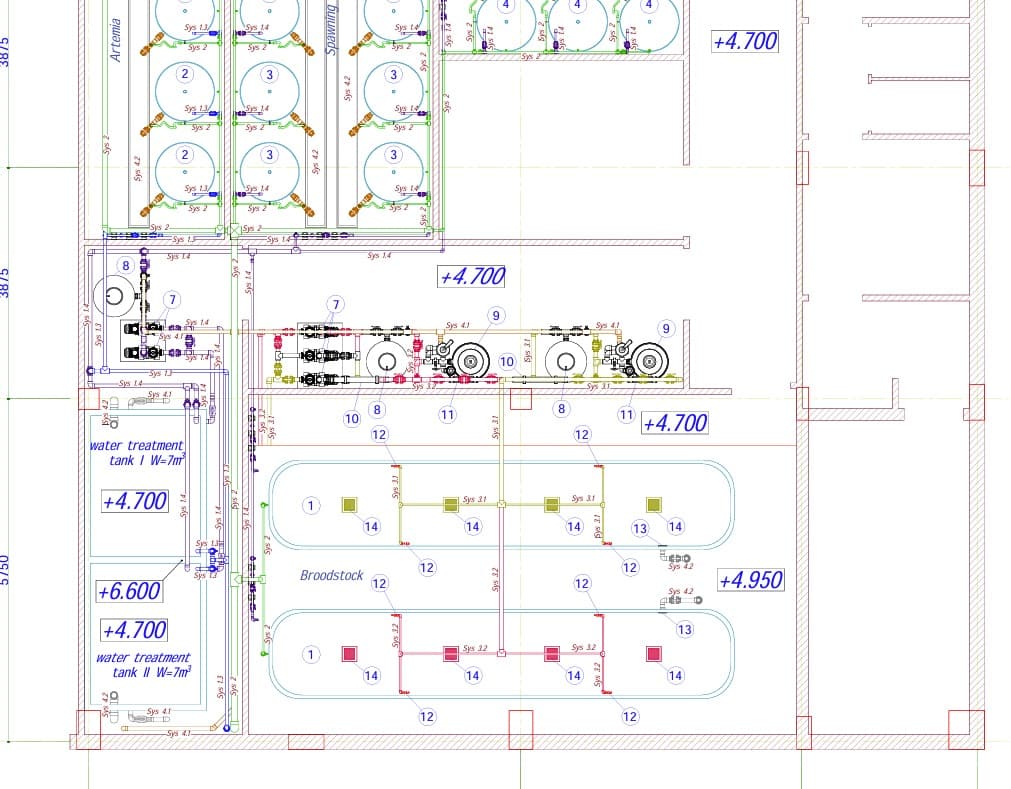
The system includes nursery tanks (2 × 150 m³), intermediate grow-out tanks (2 × 350 m³), and final production tanks (4 × 750 m³), supported by advanced water treatment systems including biofilters, mechanical filtration, ozone treatment, oxygen injection, and UV sterilization.
This project represents a comprehensive engineering solution for producing 250 tonnes of Pacific White Shrimp annually in one of the world's most challenging environments. The facility uses a multi-phase RAS approach with biofloc technology to maximize production efficiency while minimizing water consumption and environmental impact.
The system includes nursery tanks (2 × 150 m³), intermediate grow-out tanks (2 × 350 m³), and final production tanks (4 × 750 m³), supported by advanced water treatment systems including biofilters, mechanical filtration, ozone treatment, oxygen injection, and UV sterilization.
Key Performance Metrics
250
Tonnes/Year
6
Cycles/Year
45t
Standing Biomass
4000m³
Water Volume
Footprint: 2,000 m² per production unit
Water Volume: 4,000 m³ total
Water Exchange: <5% per day
Oxygen Consumption: 750g per kg feed
Feed Conversion Ratio: ≤1.55
Survival Rate: 57% (after culling)
Market Size: 16-25g average
Energy Demand: 250 kW constant
Engineering Challenges
The UAE presents unique challenges for aquaculture:
Extreme outdoor temperatures reaching 45-50°C in summer
Severe water scarcity in a desert environment
High biosecurity requirements to prevent disease introduction
Critical need for reliable oxygen supply in high-density production
Limited local expertise in super-intensive shrimp farming
The client required a facility that could operate year-round in these conditions while maintaining world-class production efficiency and profitability.
The client required a facility that could operate year-round in these conditions while maintaining world-class production efficiency and profitability.
Our Solution
Our engineering team developed a comprehensive solution addressing each challenge:
Climate Management: Insulated building design with efficient HVAC systems and energy-efficient cooling to maintain optimal water temperature despite extreme external conditions.
Water Conservation: 95% water recirculation with minimal discharge, integrated with desalination for makeup water. Total system volume of 4,000 m³ with less than 5% daily exchange.
Biosecurity: Multi-barrier approach combining ozone treatment, UV sterilization, and advanced filtration. Quarantine protocols for incoming stock.
Oxygen Supply: On-site oxygen generation (Linde SOLVOX system with 50-60 mg/L capacity) plus emergency LOX backup, with automated monitoring and failsafe systems to ensure continuous supply.
Water Treatment: 500 kg feed/day capacity biofilter, drum filters (60/80 micron), degassing units for CO₂ and nitrogen removal, and comprehensive support infrastructure including hatchery (4 million larvae/month capacity), automated feeding systems, and wastewater treatment with effluent processing and denitrification.
Climate Management: Insulated building design with efficient HVAC systems and energy-efficient cooling to maintain optimal water temperature despite extreme external conditions.
Water Conservation: 95% water recirculation with minimal discharge, integrated with desalination for makeup water. Total system volume of 4,000 m³ with less than 5% daily exchange.
Biosecurity: Multi-barrier approach combining ozone treatment, UV sterilization, and advanced filtration. Quarantine protocols for incoming stock.
Oxygen Supply: On-site oxygen generation (Linde SOLVOX system with 50-60 mg/L capacity) plus emergency LOX backup, with automated monitoring and failsafe systems to ensure continuous supply.
Water Treatment: 500 kg feed/day capacity biofilter, drum filters (60/80 micron), degassing units for CO₂ and nitrogen removal, and comprehensive support infrastructure including hatchery (4 million larvae/month capacity), automated feeding systems, and wastewater treatment with effluent processing and denitrification.
Technical Specifications
System Components:
Phase I - Nursery (Weeks 1-2):2 × 150 m³ concrete tanks
Biofloc establishment phase
Intensive monitoring and feeding
Phase II - Intermediate (Weeks 3-4): 2 × 350 m³ concrete tanks
Accelerated growth phase
Optimized stocking density
Phase III - Growout (Weeks 5-12): 4 × 750 m³ concrete tanks
Final production phase
Maximum biomass density: 15.36 kg/m³
Water Treatment Systems: Biofilter: 500 kg feed/day capacity
Mechanical Filtration: Drum filters (60/80 micron)
Ozone Treatment: For pathogen control
Oxygen Injection: Linde SOLVOX system (50-60 mg/L capacity)
Degassing Units: CO₂ and nitrogen removal
UV Sterilization: Water disinfection
Support Infrastructure: Hatchery: 4 million larvae/month capacity
Feed Storage: Automated feeding systems
Oxygen Generation: On-site PSA system
Wastewater Treatment: Effluent processing and denitrification
Desalination Unit: Freshwater production
Phase I - Nursery (Weeks 1-2):
Phase II - Intermediate (Weeks 3-4):
Phase III - Growout (Weeks 5-12):
Water Treatment Systems:
Support Infrastructure:
- Emergency Backup: LOX system + generators
Financial Performance
CAPEX
$1,240,000
Annual OPEX
$917,000
Annual Revenue
$1,690,000
Annual Profit
$652,000
Production Cost
$4.60/kg
Profit Margin
38.65%
ROI
~2 years
Projected financial performance assumes $7.50/kg sale price. Environmental benefits include minimal water consumption (<125 m³/day discharge), zero environmental impact (closed system), and local food production in food-insecure region.
Project Results
Technical Performance:
Annual production capacity: 250 tonnes whole shrimp (HOSO)
Standing biomass: 45 tonnes
6 production cycles per year
Feed Conversion Ratio: ≤1.55
Survival rate: 57% (after culling)
Market size: 16-25g average
Financial Performance (Projected): CAPEX: $1.24M USD (design + equipment)
OPEX: $917K USD annually
Production cost: $4.60/kg
Annual revenue: $1.69M (at $7.50/kg)
Annual profit: $652K USD
Profit margin: 38.65%
ROI: ~2 years
Environmental Benefits: Minimal water consumption (<125 m³/day discharge)
Zero environmental impact (closed system)
Reduced reliance on wild-caught shrimp
Financial Performance (Projected):
Environmental Benefits:
- Local food production in food-insecure region
"Vismar Aqua's engineering team demonstrated exceptional expertise in designing our shrimp facility. Their attention to detail, understanding of biofloc technology, and ability to adapt to our local conditions was impressive. The system design is world-class."
Project Manager
Aqua Bridge Project, UAE
Also available in:
Interested in Similar Solutions?
Let us help you achieve success with your aquaculture project.